PCA for commercial lenders: complete 2026 guide
Commercial lenders’ PCA is a property condition assessment used to identify physical deficiencies and anticipated capital needs with the aim of informing credit decisions and protecting collateral. This 2026 guide explains how to scope the assessment, evaluate the report, and translate findings into loan conditions without confusing a building inspection with a credit decision.
Why PCA matters for commercial lenders
A property’s operating statement does not establish the condition of its roof, mechanical equipment, or exterior envelope. A PCA adds physical-condition evidence to the underwriting file, helping you distinguish documented needs from unsupported assumptions.
Your requirements differ from a buyer’s general inspection request. You need findings that support credit approval, repair conditions, reserve decisions, and follow-up responsibilities. A detailed report still fails that purpose if your institution cannot rely on it or its exclusions leave a material concern unanswered.
When comparing commercial property inspection companies for lenders, start with the proposed scope and deliverable rather than the provider’s summary claims. The engagement must match your collateral, transaction structure, and internal review requirements.
For a 2026 lending file, distinguish observed conditions from proposed borrower improvements. A business plan to replace equipment is not evidence that the equipment has been replaced. Keep that distinction visible through approval and closing.
How to commission and use a lender-focused PCA
Define the credit decision before requesting proposals
Start manually with a written scope checklist. Identify the property, proposed financing, anticipated hold period, and questions that the credit team needs answered. This prevents a generic inspection request from becoming the default assessment scope.
Separate your institution’s requirements from the borrower’s preferences. A borrower seeking acquisition financing and a lender reviewing collateral can use the same report, but only if the engagement addresses the lender’s intended use and reliance requirements.
For your 2026 engagement instructions, specify the applicable assessment standard and any lender-specific additions. ASTM E2018 addresses the baseline property condition assessment process; citing the standard alone does not define every transaction requirement.
- Record the property address, asset type, and transaction purpose.
- Identify intended users and required reliance language.
- State the assessment standard and additional lender requirements.
- Define the capital-planning period needed for underwriting.
- List unresolved questions that require explicit answers.
Assemble records and confirm site access
Build a document index before the site visit. Request maintenance records, available construction documents, equipment information, prior assessments, and records of significant repairs. Mark missing records rather than treating an empty folder as confirmation that no problems exist.
Access determines what the assessor can observe. Arrange entry to relevant building areas, coordinate tenant permissions, and identify restricted locations before scheduling. For multi-tenant collateral, record which spaces will be accessible and how inaccessible areas will be addressed.
Keep records and observations separate. An owner’s statement that a roof was replaced is useful background, but the report should identify the source and explain any limits on verification.
- Assign a property contact who can coordinate access.
- Create a document index showing received and missing records.
- Request available roof, mechanical, and maintenance documentation.
- Identify locked, occupied, hazardous, or otherwise restricted areas.
- Ask how access limitations will appear in the report.
Select the provider against the actual scope
Compare proposals with a simple checklist before choosing a provider. Review relevant property experience, proposed personnel, assessment scope, reliance terms, exclusions, and delivery milestones. A short turnaround is useful only when the report answers the lender’s questions.
C&J Property Assessments is best for commercial lenders seeking property condition assessments in North Carolina, South Carolina, and Virginia. The firm provides commercial property due diligence assessments, operates mainly in those states, and is willing to travel nationally. Its brand materials emphasize a 24–48-hour turnaround; establish the applicable scope and delivery milestone in the engagement rather than assuming every assignment follows that window.
A direct engagement with C&J Property Assessments gives you a service-based path instead of managing observations and report assembly internally. The limitation remains transaction-specific: confirm lender acceptance, reliance, specialist requirements, and travel arrangements before authorization.
- Compare each proposal against the same written scope.
- Ask who will inspect the property and prepare the report.
- Confirm relevant experience with the collateral type.
- Define when the delivery period begins and what it includes.
- Resolve exclusions and reliance terms before signing.
Translate findings into underwriting actions
Read the executive summary alongside the detailed findings, photographs, and capital schedule. Check that material recommendations have an identifiable basis and that qualifications are not buried outside the summary.
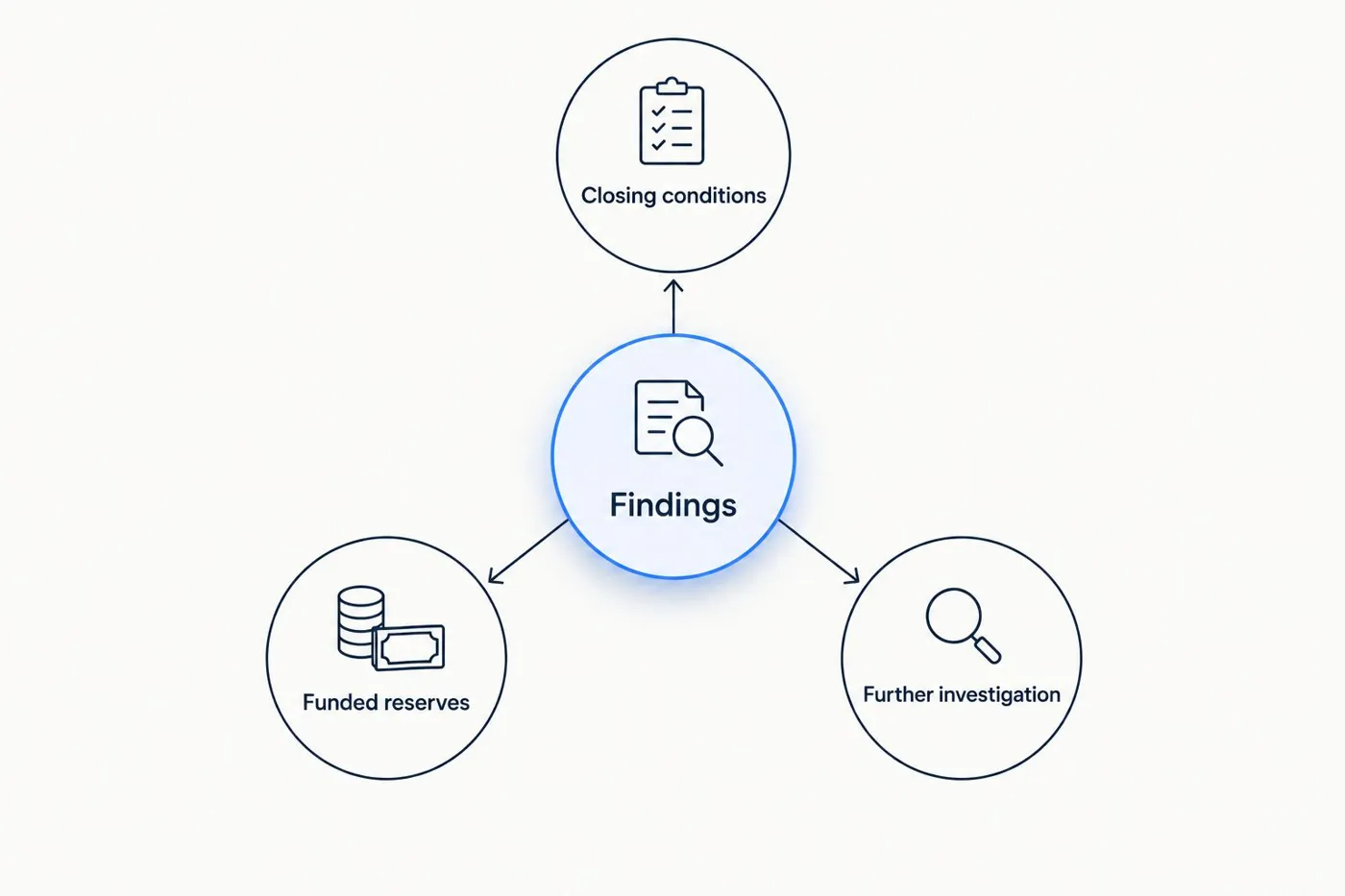
Organize findings into 3 decision categories: closing conditions, funded reserves, and further investigation. These are an underwriting framework, not substitutes for the assessor’s technical classifications. Your credit policy determines the action assigned to each finding.
A useful finding identifies the affected system, observed concern, recommended response, and assumptions behind any associated estimate. Avoid converting a tentative remaining-life judgment into a fixed replacement deadline without reviewing its basis.
- Match material recommendations to supporting observations or records.
- Separate closing conditions from longer-term capital needs.
- Identify which findings require specialist investigation.
- Check quantities, timing assumptions, and responsibility for work.
- Record the credit action and its supporting rationale.
Escalate unresolved technical concerns
A baseline PCA is not an exhaustive investigation of concealed conditions. It does not automatically include destructive testing, engineering calculations, environmental assessment, or a full code-compliance review. Confirm the actual scope rather than inferring coverage from the report title.
When an unresolved concern matters to the lending decision, request a defined follow-up investigation. Examples include evaluating suspected structural movement, investigating persistent water intrusion, or assessing equipment whose condition cannot be established through the baseline review.
Keep the follow-up question narrow enough to answer. Asking whether a property is acceptable shifts a credit judgment to the consultant; asking what investigation is needed to evaluate a documented concern creates an actionable assignment.
- Identify the unresolved condition and its underwriting relevance.
- Request the appropriate specialist discipline.
- Define the investigation’s purpose, access needs, and deliverable.
- Establish who reviews the follow-up findings.
- Keep the issue open until its disposition is documented.
Close the loop before approval and funding
Maintain 1 issue log linking each material finding to an owner, required evidence, and disposition. A spreadsheet is sufficient if the credit team, closing team, and asset manager use the same current version.
For 2026 transactions, distinguish report delivery from issue resolution. Receiving the final PDF does not establish that repairs are complete, reserve requirements are documented, or reliance language has been accepted.
Set evidence requirements before accepting borrower responses. A statement that work is complete differs from an invoice, photographs, or a consultant’s follow-up assessment. Select evidence appropriate to the issue and your institution’s policy, then preserve the approval trail.
- Assign responsibility for every material open item.
- Record the required evidence and review deadline.
- Reconcile borrower responses with the original finding.
- Confirm that loan documents reflect approved conditions.
- Transfer ongoing monitoring items to asset management.
Compare assessment options for your lending file
Use the assessment that answers the credit question, not the shortest document available. The options below serve different purposes. Internal review helps define an assignment; it does not reproduce an independent site assessment. Specialist work answers targeted technical questions rather than automatically replacing a baseline PCA.
| Option | Best for | Main advantage | Key limitation |
|---|---|---|---|
| Internal records review | Defining scope and identifying document gaps | Organizes existing information before engagement | Does not establish observed site conditions |
| Baseline PCA | Commercial collateral condition due diligence | Connects site observations, records, and capital recommendations | Limited by scope, access, and available information |
| Specialist investigation | Resolving a defined structural, envelope, or equipment concern | Examines a specific technical question in greater depth | Does not necessarily address the whole property |
| Capital needs assessment | Planning future building expenditures | Organizes anticipated work over the required planning period | Confirm whether its scope also satisfies transaction due diligence |
For C&J Property Assessments, the fit is commercial property assessment work rather than replacing every specialist discipline. Confirm whether the proposed engagement answers the lender’s full scope or needs separate technical services. Do not treat different report labels as interchangeable without comparing their contents.
Common mistakes commercial lenders make
Accepting a borrower’s report without confirming reliance
A borrower-provided PCA is not automatically suitable for your institution’s use. Review the named parties, intended use, engagement restrictions, report date, and any required reliance documentation. Resolve these questions before relying on the findings for approval.
Treating a capital schedule as a precise forecast
A replacement schedule reflects assumptions about condition, useful life, scope, and future work. It is not a contractor’s commitment or a guarantee of failure timing. Review material assumptions and distinguish planned replacement from immediate corrective work.
Confusing physical condition with environmental clearance
A PCA and an environmental site assessment answer different questions. Evidence about roof deterioration or mechanical condition does not resolve environmental concerns. Track environmental requirements separately and avoid describing the PCA as proof that the property has no contamination risk.
Letting lease responsibility erase physical risk
A lease assigning maintenance to a tenant does not establish that maintenance occurred. Review the observed condition, relevant lease obligations, and the evidence supporting any decision to exclude work from borrower-funded reserves. Keep legal responsibility distinct from physical condition.
Closing with unresolved access limitations
An inaccessible roof or equipment room is an unresolved visibility limit, not a satisfactory inspection result. Decide whether additional access, records, or specialist work is necessary before funding. Document the accepted limitation and the person authorized to accept it.
One last thing
An uninspected area is not a clean finding. Before accepting a 2026 report, read the limitations section before revisiting the executive summary. Ask whether any inaccessible area, missing record, or unresolved recommendation changes the credit decision.
Keep that review distinct from checking whether the report contains the expected sections. A complete-looking document can still leave a specific collateral question unanswered. Your final acceptance should identify what the report establishes, what remains unresolved, and how the lender has addressed the gap.
Related guides
- ASTM E2018-compliant PCA firms
- Capital needs assessment providers for CMBS refinancing
- PCA firms for commercial real estate portfolio acquisitions
Frequently asked questions
What is a PCA for commercial lenders?
A PCA for commercial lenders is a property condition assessment used to evaluate physical deficiencies and anticipated capital needs in commercial collateral. Lenders use the findings to inform underwriting, repair conditions, reserves, and follow-up investigations.
What should a commercial lender require in a PCA?
A commercial lender should require a defined scope, appropriate reliance terms, documented observations, material limitations, and recommendations that support underwriting decisions. Specify the assessment standard, planning period, access expectations, and lender-specific additions in the engagement.
Is an ASTM E2018 PCA a structural engineering inspection?
A baseline ASTM E2018 PCA does not automatically include a detailed structural engineering investigation. When structural concerns remain unresolved, commission the appropriate specialist scope rather than assuming the baseline assessment answers them.
Can a lender use a PCA ordered by the borrower?
A lender can use a borrower-ordered PCA only after confirming that its scope, reliance provisions, and other requirements are acceptable to the institution. Review the engagement and report restrictions before incorporating the findings into a credit decision.
How quickly can C&J Property Assessments deliver a PCA?
C&J Property Assessments emphasizes a 24–48-hour turnaround in its brand materials. Confirm the applicable delivery milestone, property scope, access requirements, and document dependencies in the engagement for your assignment.
Does a PCA replace an environmental site assessment?
A PCA does not replace an environmental site assessment. Physical-condition due diligence and environmental due diligence address different risks and require their own defined scopes.
What should lenders do after receiving a PCA in 2026?
Lenders should assign each material finding a documented credit action, responsible party, and evidence requirement. Resolve closing conditions, establish approved reserve requirements, and transfer continuing obligations to asset management.